
Lochnager Crater
You get dizzy looking down

The 1st of July 1916 marked the beginning of the battle of the Somme. It started with a bang. At 7:20am, Hawthorne Ridge exploded. The incident was filmed by British war cinematographer, Geoffrey Malins.
There was another mine explosion just 8 minutes later and 4 miles away. This created Lochnager Crater. This was one of the largest manmade explosions of that time.
During my trip to the Somme in July 2025, I did not get to see the Hawthorne Ridge craters, but I did get to walk around Lochnager. You can look up at the history and statistics of the crater at the hyperlink above. Reading it is impressive. Photos are impressive. But standing at the edge is an entirely different experience. It’s so deep that you get dizzy looking down. As your eyes are drawn down the chalky scars into the center of the pit, the realization sinks in. You’re staring into a mass grave.
It is awe inspiring and unnerving. Hindsight gives us a different sort of context. We know that the scope of this horror is small in comparison to what humanity has achieved in destruction since. Atomic bombs like in Hiroshima occurred just barely a generation later. But I’m not here to talk about that. I’m here to talk about Lochnager Crater.
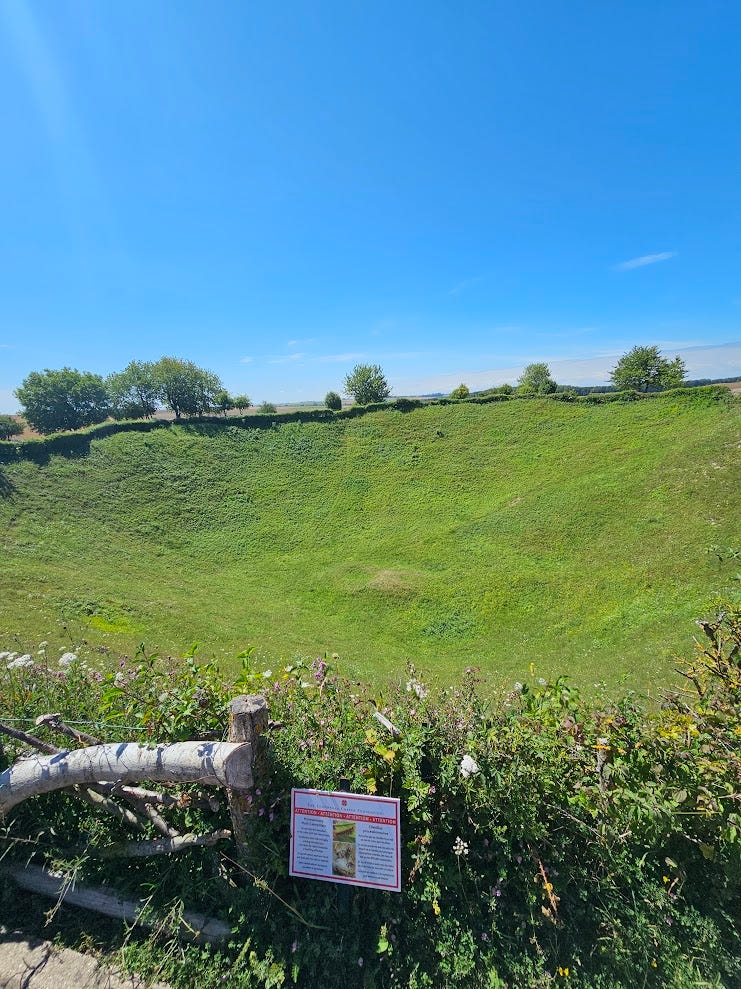
This photo that I took does not do the size of the crater justice. The large trees behind it might give you some sense of the scale. It was impossible to capture. The depth is approximately 30 meters (98 feet). The width is about 100 meters (330 feet). And as impressive as that sounds, it’s shocking to see in real life.
Today, the site is privately owned by Richard Dunning, who purchased the site in 1978 to save it from being filled in. He started a charitable foundation in its name. It’s an incredible site to visit.
We saw many old battlefields and memorials on our tour. Today marks 110 years since the start of the Battle of the Somme. These sights that were once filled with such destruction and suffering are now integrated into a pastural landscape. Farmers reclaimed most of the fields. The found dead were moved into neatly manicured cemeteries. Monuments are built to commemorate those never found.
There is something about seeing the grass and flowers
growing over the scars of war that gives a sense of hope, healing, and renewal.